

Japanese knotweed is frequently reported as a significant property risk. It has a reputation for growing through concrete, tarmac and brick walls.
Consequently, it can be a show-stopper when identified on property that’s up for sale. While much of the physical damage to buildings caused by Japanese knotweed is rare, its reputation has caused it to be included as a specific risk on the Law Society’s Property Information Form (TA6), which accompanies most house sales and which must be completed by the seller as part of a property transaction. As such, it is vital that homeowners, whether they plan to sell their property or not, are able to identify Japanese knotweed and survey their property for its presence.
New guidance from the Royal Institution of Chartered Surveyors requires valuation surveyors to check beyond a property’s boundaries in order to check for Japanese knotweed that might be located nearby. Even if it’s several metres away Japanese knotweed can still ‘blight’ a property, putting off some sellers and impacting the property’s value.
If you don’t know that knotweed affects your property, you could get a nasty surprise when and if it is eventually identified on a survey. This could result in legal action being taken against you for alleged misrepresentation of a property risk when you decide to sell or re-mortgage the property. It could also result in action being taken against you by a neighbour, if they can show the Japanese knotweed came from your land and has caused your neighbour a nuisance that results in damage costs.
Identifying Japanese knotweed
Fortunately, identifying Japanese knotweed is easier than it is for many other plants. Part of its appeal, which caused it to be introduced and planted in the UK in the mid 1800s, is that it has some pretty unique and striking features, which set it apart from other garden ornamentals. As a perennial that survives through the winter as an underground rhizome, producing annual stems in the spring that die back each winter, its unique features appear differently at different times of the year.
The easiest time of year to identify Japanese knotweed
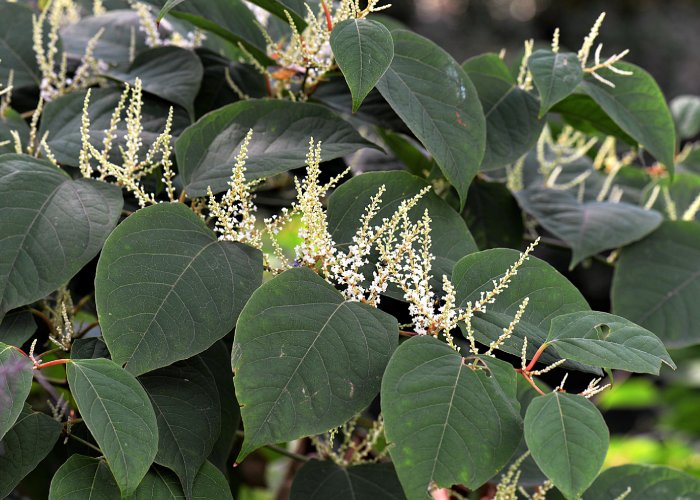
Probably the best time to identify Japanese knotweed is in late summer, around August and September. This is when it has reached its full height and is in full flower. Not many other plants of a similar size flower this late in the season, so the fact that it’s in flower in late summer is a good identification marker. The flowers appear as tiny white individual flowers on spikes, or panicles that are around 10cm long. They vary in shape and orientation from upright spikes to wavy ‘noodles’ that point in all directions.
Before the flowers appear, the leaf shape and architecture of the stems can also be clear giveaways, when they have fully formed around early May time. The stems grow very tall, up to around 3m in height and are very straight until their very tops, which bend over with the weight of the abundant leaves. The stems emerge in clumps from a central base called a crown and have clear nodes that make the stems very similar in appearance to bamboo, which Japanese knotweed is often mistaken for. However, unlike bamboo, knotweed stems can be snapped relatively easily, revealing the completely hollow interior between the nodes. The stems are a pale green in colour with dark purple spots. At their tips, where the stems bend over, a zig-zag pattern can be seen, where the stems alternate in forming short kinked sections after each node. This alternating pattern is also followed by the distribution of leaves and side branches on the stems. Many similar looking plants like dogwood and Himalayan honeysuckle have side-stems and leaves that appear opposite each other, unlike the alternate pattern in Japanese knotweed.
Identifying Japanese knotweed outside the growing season
Outside of the growing season, Japanese knotweed continues to reveal some characteristic features that help with its identification. In autumn and winter, the leaves fall and the annual stems die, leaving persistent, straw-coloured, bamboo-like canes in distinctive clumps. These can be quite conspicuous, as the other vegetation that often surrounds and partially hides the Japanese knotweed dies back for the winter.
Often, by the next spring, many of the dead canes, which are quite brittle, will have been knocked down by the winter weather or by the movement of people and animals. In early March, the bright red crown buds can be seen amongst the snapped and standing canes. These resemble, in size and shape, the end of a thumb. Within a few weeks, into April, new stems rapidly emerge from these red buds, appearing like dark purple spears of giant asparagus. The rate of growth at this time is phenomenal, with heights of over a metre being reached within a few weeks.
Signs of Japanese knotweed
No matter what time of year it is, there are always features that can be found that will reveal the presence of knotweed. That is of course, unless someone has cleared away any such evidence. This can happen when homeowners move into a property that was renovated or significantly tidied up for sale. Scraping areas of crowns and clearing away winter canes will still leave substantial knotweed rhizomes in the ground, which can be present several metres deep and several metres distant from the crowns where the annual stems emerge. These residual rhizomes will reveal the Japanese knotweed as a slightly different type of shoot in the spring, emerging from buds on the rhizomes rather than the crowns. The rhizome buds are smaller than crown buds and result in smaller shoots forming. However, these too are quite distinctive, appearing as dark purple shoots of tightly rolled leaves.